
In everyday operation, the slight “click” heard when opening or closing a microwave door is actually the physical feedback of the safety system’s activation. Behind this action is a precision door interlock mechanism built with a microwave door micro switch. As high-frequency electromechanical components inside home appliances, these micro switches are not only responsible for sensing the open/closed state of the door but also act as a core physical barrier to prevent microwave radiation leakage by directly controlling internal circuits. The microwave oven door micro switch plays an irreplaceable role in ensuring appliance safety due to its unique technical characteristics.
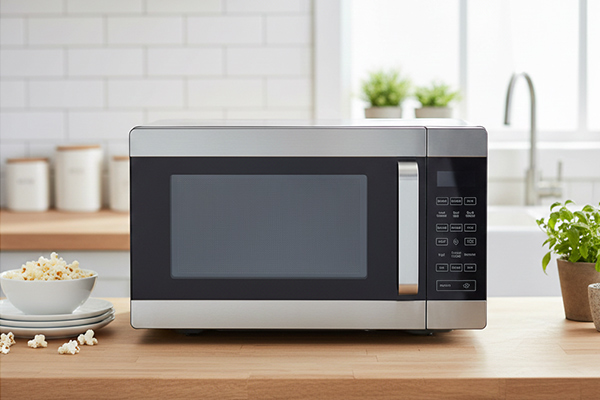
Working Principles of Micro Switches for Microwave
In microwave design, the door switch on microwave serves as a key bridge that converts the mechanical displacement of the door into electrical signals. When the door latch presses the actuator, the internal spring moves rapidly to achieve the physical connection or disconnection of the circuit.
To ensure absolute safety, the system usually adopts a multi-level interlock design, including:
-
Primary and Secondary Switches: Responsible for controlling the power supply of the main circuit, ensuring the power system is not energized when the door is not closed.
-
Monitor Switch: Acting as safety redundancy, this microwave door switch triggers a forced short-circuit protection logic to blow the fuse under abnormal conditions (such as primary switch welding), forcibly cutting off the power.
-
Versatility of Contact Forms: Depending on the circuit logic requirements, micro switches can provide various contact forms such as Normally Open (NO), Normally Closed (NC), and Changeover (CO) to achieve precise system state feedback and interlock control.
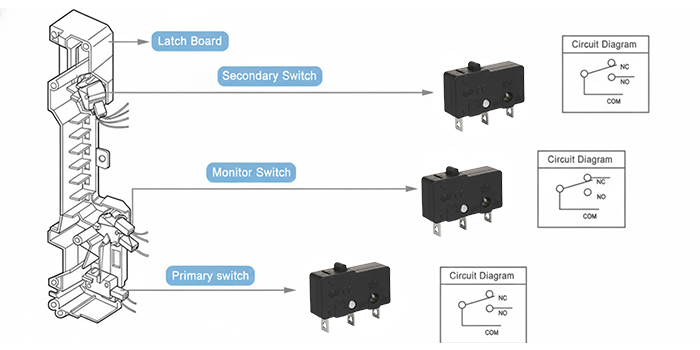
Multi-level Door Interlock Safety Defense System of Microwave
According to microwave safety design specifications, a single switch cannot completely eliminate the risk of radiation leakage. Therefore, the system builds a strict defense chain through microwave oven door micro switches with different functions:
-
Primary and Secondary Interlock Protection: This is the first line of defense. The primary interlock switch is connected in series with the magnetron power supply circuit, and the secondary interlock switch acts as a backup. When the door is opened, both must disconnect the circuit at the same time to ensure the microwave generator stops working immediately.
-
Monitor Switch End-of-Line Defense: This is a unique safety logic. The monitor switch and interlock switches form an interlocking relationship. If the primary or secondary microwave door switch fails to disconnect when the door is opened, the monitor switch will actively create a controlled short-circuit path to quickly blow the main fuse. This “fail-safe” logic ensures that users will not be exposed to microwave radiation under any extreme failure conditions.
Related reading: Microswitch Application in Safety Interlocking of New Energy System
How Microwave Door Switch Achieves Precise Control
The “sensing” of a door switch on microwave is not a simple on/off action, but is achieved based on strict mechanical displacement control:
-
Precise Sensing of Mechanical Travel: Each microwave door micro switch works by sensing the subtle displacement of the door latch. To achieve precise control, the switch needs to strictly limit the Pretravel (PT) and Overtravel (OT) to ensure that the circuit can be closed accurately at the moment the door is closed to the safe position.
-
Impact of Movement Differential: The movement differential of a micro switch is crucial for the stability of the door interlock. An extremely small movement differential ensures that the switch responds to changes in the door state in split seconds, avoiding safety lags or logic misjudgments caused by displacement deviations.
-
Physical Linkage Synchronization: In a multi-switch interlock structure, the Operating Position (OP) of each microwave oven door micro switch must maintain high consistency. This fireball mechanical coordination ensures that the action sequence of the switches during the door process fully meets the safety requirements.
Differences Between Micro Switches for Microwave and Basic Micro Switches
Based on industry standards, the microwave door micro switch and basic micro switches have significant differences in several key dimensions:
-
Environmental Performance and Insulation Protection: Dedicated switches for microwaves must withstand high temperature and high humidity environments generated in the cavity. Therefore, the housing materials of a door switch on microwave usually have better Comparative Tracking Index (CTI) performance to ensure creepage protection in humid environments.
-
Electrical Load and Contact Grade: Microwave ovens are high-power inductive load equipment. Dedicated switches must use high-grade silver alloy contacts to reduce contact resistance and effectively prevent contact welding or carbon buildup caused by frequent switching.
-
Material Safety and Compliance Certification: To meet mandatory safety requirements, these switches use engineering plastics (such as PPS) with high flame retardancy and must pass strict Glow Wire Tests (GWT).
-
Reliability Redundancy of Mechanical Life: The mechanical life of a microwave door switch is usually pushed to tens of millions of cycles. This high level of redundancy ensures that the mechanical structure will not jam due to metal fatigue or environmental corrosion over the product’s entire life cycle.
Conclusion
In summary, although the micro switch is a miniature component, it is the cornerstone of microwave oven safety. By creating a gap with basic models in terms of environmental tolerance, electrical load, and action precision, the microwave oven door micro switch ensures the operational reliability of home appliances under extreme conditions. Selecting a professional micro switch supplier with a senior R&D background, strict quality control, and complete international safety certifications is essential to enhance product durability and safeguard both brand value and user safety.

 English
 Russian