
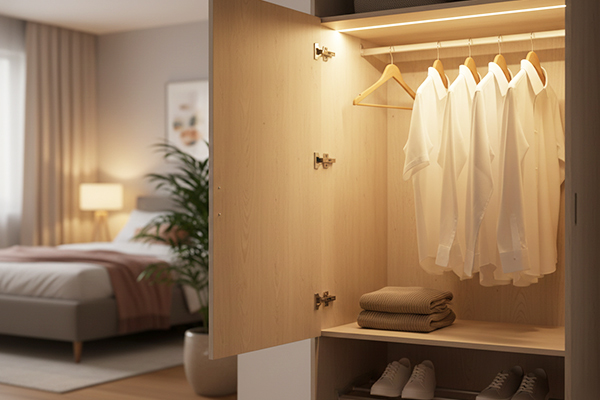
In the modern furniture manufacturing industry, with the rise of smart home technology and whole-house customization, automated lighting systems have evolved from premium add-ons to standard features for modern wardrobes. While various sensing technologies—ranging from infrared sensors to magnetic reed switches—have entered the market to achieve the “light on when open, light off when closed” functionality, the micro switch remains at the core of the industry. This is due to its exceptional mechanical lifespan and unrivaled actuation accuracy, making it the top choice for professional furniture manufacturers prioritizing long-term stability and reliability.
How Micro Switches Work in Wardrobe Automation
The application of micro switches in wardrobe lighting systems is fundamentally based on a circuit control logic driven by precise mechanical displacement.
-
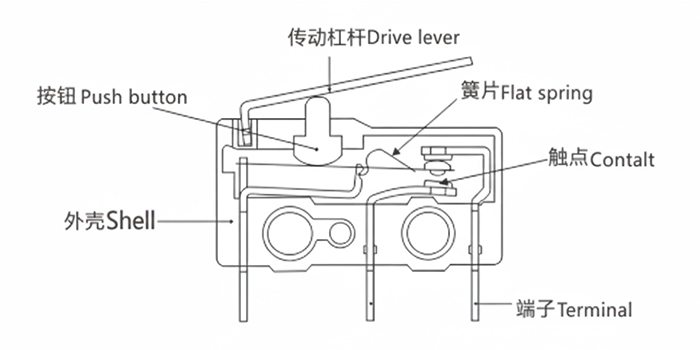
Mechanical Triggering Explained: The core of a micro switch lies in its “snap-action” mechanism, which is why it is also commonly referred to as a snap action micro switch. Through a minute physical displacement—such as the pressure exerted by the edge of a wardrobe door on the actuator—an internal spring-loaded mechanism produces an instantaneous snap of the contacts. This mechanical trigger does not rely on electronic algorithms, providing a robust hardware foundation for wardrobe automation.
-
Actuation Logic: Typical wardrobe lighting control systems utilize Normally Closed (NC) contacts. When the wardrobe door is closed, it depresses the switch actuator, forcing the internal contacts open and cutting the circuit. As soon as the door is opened, the pressure is released, and the internal spring mechanism instantly resets to its closed-contact state, completing the circuit and activating the LED light.
-
Hardware-Level Stability: Compared to electronic sensors, micro switches do not require complex PCB support or standby power consumption. This purely physical control solution ensures highly consistent response rates, even in high-frequency usage scenarios.
Related reading: Micro Switches: From Snap-Action to Precise Control
Comparison: Wardrobe Micro Switches vs. Alternative Sensing Technologies
Magnetic Reed Switches for Wardrobe Light
While magnetic reed switches are easy to install and low-cost, they have significant drawbacks in industrial furniture applications. First, their contact rating is typically very small (often less than 0.5A). When driving high-power LED strips, inrush current can easily cause the contacts to weld or burn out. Second, magnetic force diminishes over time, and the strict alignment required for installation can lead to failure after prolonged use. In contrast, wardrobe micro switches offer higher load capacity (often 5A or more) and a deterministic mechanical lifespan.
PIR/IR Sensors for Wardrobe Light
Infrared sensors (PIR or reflective IR) have become popular but are susceptible to environmental interference. Because IR sensing depends on heat sources or reflected signals, sensitivity drops significantly when ambient temperatures approach body temperature or when dark-colored, light-absorbing clothing is stored in the wardrobe. Furthermore, electronic sensors often have a detection cycle, leading to a delay in lighting. Micro switches provide a “hard trigger” that is unaffected by light, color, or temperature, ensuring 100% instantaneous response.
Photoelectric/Optical Sensors for Wardrobe Light
Optical solutions control lighting by detecting changes in light intensity within the cabinet. Their main pain point is a high dependency on the sealing of the wardrobe. If the door gaps leak light or if external ambient light changes drastically, the lights may stay on even when the door is closed, leading to energy waste and reduced LED lifespan. Micro switches depend solely on the physical position of the door; once the door is shut, the circuit is physically disconnected, providing superior stability.
Key Advantages: Why Manufacturers Prefer Micro Switch for Wardrobe Light
High Mechanical Longevity and Long-term Stability
High-quality micro switches are typically tested for over 1,000,000 cycles. For a wardrobe opened only a few times a day, this translates to an effective lifespan of 15 to 20 years, ensuring that the lighting system’s durability matches the depreciation cycle of the furniture itself.
Versatile Actuators for Various Wardrobe Designs
To accommodate different wardrobe styles, micro switches offer a variety of actuator options:
Swing Doors: Typically use straight levers or small roller levers installed at the top corner of the cabinet near the hinges.
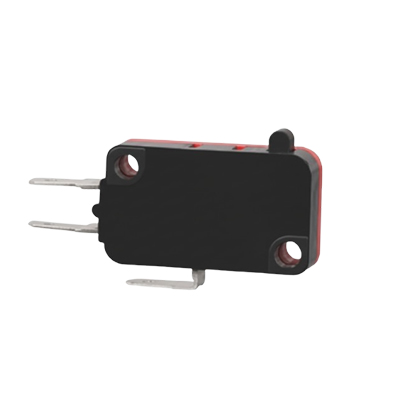
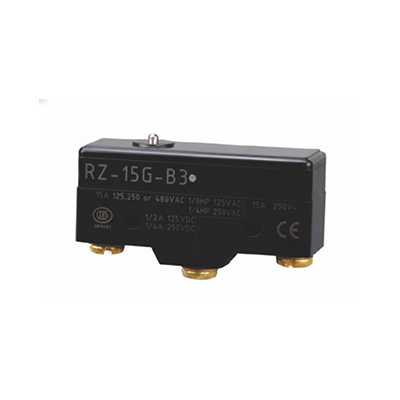
Sliding Doors: Utilize roller levers that allow the horizontal movement of the door frame to trigger the switch smoothly. For heavy-duty sliding doors or larger cabinet structures, the industry-standard basic micro switch series (such as Liyond RV or RZ micro switch series) is often preferred for its robust construction and higher current load capacity.
Cost-Effectiveness and Simplified Circuit Integration
Since micro switches can directly handle higher electrical loads, manufacturers do not need to integrate expensive sensing modules or additional relays into the circuit. This reduces the Bill of Materials (BOM) cost and significantly simplifies the assembly process, while also lowering the rate of after-sales maintenance caused by aging electronic components.
Selection Guide: Choosing the Right Micro Switch for Wardrobe Light
During the selection process, we recommend focusing on the following three technical dimensions:
Electrical Parameters: Ensure that the switch’s rated voltage and current are higher than the output power of the LED driver to prevent contact overload.
Ingress Protection (IP Rating): Given the presence of fabric fibers and dust inside wardrobes, selecting a switch with adequate dust protection (such as IP4X or higher) is more reliable.
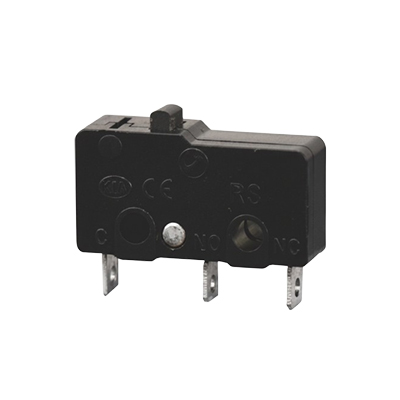
Installation Space: With the trend toward minimalist furniture, while the standard basic series remains a staple for reliability, the miniature micro switch series (such as Liyond RS micro switch series) and the subminiature micro switch series (such as Liyond RLXW20 micro switch series) are increasingly favored. Their compact footprints allow for seamless, concealed installation within narrow cabinet frames or behind hinges, maintaining the aesthetic integrity of the wardrobe.
Liyond: Your Professional Micro Switch Solutions Provider
As a professional micro switch manufacturer, Liyond supplies a wide range of high-quality micro switches applied in industrial control, household appliances, and precision instruments. In the specialized niche of wardrobe lighting automation, our products have become the trusted choice for many furniture component integrators due to their excellent electrical performance and mechanical durability.
We understand that different industries have diverse requirements for switching components. Therefore, Liyond offers a comprehensive product line to meet varied needs:
-
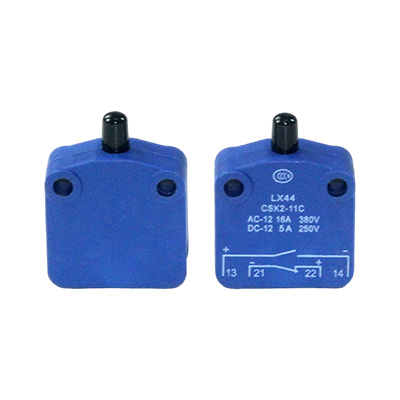
Precision Subminiature series (RLXW20/LX44): Ideal for high-end furniture integration where space is at a premium.
-
Heavy-duty Basic series (RV/RZ): Built for robust applications requiring high load capacity.
-
Versatile Miniature RS series: A flexible solution for a wide range of mounting environments.
Our team supports customized actuator designs for specific installation environments. Through continuous innovation and rigorous quality control, we are committed to providing precise, stable, and cost-effective component solutions for our global clients.
Conclusion
In conclusion, micro switches achieve a perfect balance between reliability, response speed, and overall cost-effectiveness. While various sensing solutions exist, micro switches remain the preferred solution for wardrobe lighting automation in the high-end furniture manufacturing sector, where long-term durability and brand reputation are paramount. Choosing a high-quality micro switch supplier is not just about selecting a component; it is about providing a solid technical guarantee for the long-term reputation of your furniture brand.

 English
 Russian