
In industrial electrical design and equipment maintenance, accurately distinguishing between Normally Open (NO) and Normally Closed (NC) micro switch contacts is fundamental to ensuring correct control logic. This guide provides standardized methods for micro switch terminal identification and multimeter verification to assist engineers in rapid selection and troubleshooting.
Physical Identification of Micro Switch Terminals
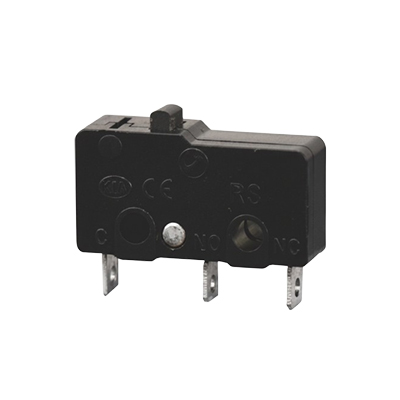
Industrial-grade micro switches typically feature standardized markings on the housing or near the terminals, which is the most direct way to identify the contact type:
“NO” (Normally Open): The circuit is open in its default state (no external force applied) and closes only when the actuator is triggered.
“NC” (Normally Closed): The circuit remains closed in its default state and opens only when the actuator is triggered.
Three-terminal (SPDT) Configuration: In standard Single Pole Double Throw (SPDT) micro switches, the Common (COM) terminal is usually positioned in the center, flanked by the NC and NO terminals. Always refer to the circuit diagram embossed on the housing for specific logic.
Electrical Testing Procedures for Micro Switches
When physical markings are missing or when electrical performance must be verified, use a digital multimeter in continuity or resistance (Ω) mode.
Testing in Default State (Inactive):
If the multimeter beeps or shows a resistance reading near 0 Ω, the path is identified as Normally Closed (NC).
If the multimeter does not beep and displays “OL” (Open Loop) or infinity, the path is identified as Normally Open (NO).
Verification in Triggered State (Active):
Normally Open (NO): Upon pressing the actuator, the circuit should close instantly (beep sounds, resistance drops to near zero).
Normally Closed (NC): Upon pressing the actuator, the circuit should open instantly (beep stops, resistance goes to infinity).
Operational Key Points:
Always disconnect the power supply before testing. Ensure measurements are taken under no-load conditions to prevent damage to the instrument.
Abnormally high resistance readings may indicate contact oxidation or poor contact integrity.
Visual Inspection Methods for Micro Switch Structures
In specific scenarios, the terminal type can be identified by observing the mechanical position of the internal contact leaf. This method is generally suitable for simple-structure micro switches:
Static Observation: The terminal that the contact leaf physically touches in its natural state is the Normally Closed (NC) terminal.
Dynamic Observation: The terminal that the leaf snaps to and contacts after the actuator is pressed is the Normally Open (NO) terminal.
Precautions: This method is primarily used for switches with transparent housings or detachable structures. For industrial-grade sealed switches, electrical testing is preferred to maintain the integrity of the Ingress Protection (IP) rating.
Selecting the Right Micro Switch Contact Configuration
In industrial applications, the choice of contact logic and material significantly impacts system reliability and safety:
Safety Logic Considerations: In critical safety loops, such as limit switches or emergency stops, NC contacts are typically recommended. This follows the Fail-safe principle: if a wire breaks or a connection fails, the control loop will detect the open circuit and initiate a protective shutdown.
Application Matching: Depending on the system logic, functions like start, reset, or general counting often utilize NO contacts, sending a signal pulse only when triggered.
Contact Material Selection: The choice of contact material should be based on the actual electrical load (voltage, current type, and power rating) and operation frequency. For varying switching requirements, refer to the product datasheet to select the appropriate contact specification, ensuring stable contact resistance and breaking capacity throughout the intended lifecycle.
Related reading: How Micro Switch Contact Materials Affect Performance
As a professional micro switch manufacturer, Liyond produces and sells a full range of high-performance micro switches widely used in industrial control and various automation equipment. We offer diverse specifications to ensure a precise match for your industrial project requirements. If you require professional advice or technical support regarding product selection or application, please do not hesitate to contact our technical expert team.

 English
 Russian