
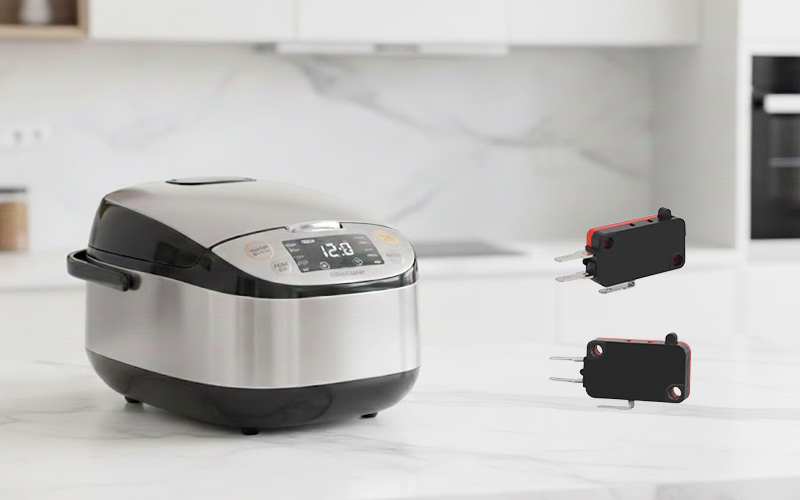
The rice cooker is an indispensable appliance in the modern kitchen, significantly simplifying the cooking process. However, the core control component that enables key functions like “one-touch cooking” and automatic warming is the micro switch.
The micro switches play a critical role in safety control and program switching within the rice cooker. It is responsible for precisely cutting off the main heating circuit and switching to the keep-warm state when the rice is cooked or the temperature reaches a preset threshold, thus ensuring food quality and electrical safety.
Understanding the Micro Switch in Rice Cookers
Definition and Function of the Rice Cooker Micro Switch
A micro switch employs a snap-action mechanism, so it is also known as a snap-action micro switch. It is characterized by small contact gaps, quick action, and high sensitivity, allowing for instantaneous connection or disconnection of a circuit with minimal force. In high-power applications like rice cookers, the rapid action of the micro switch is crucial because it minimizes arcing between contacts, ensuring control reliability and prolonging operational life.
Within the rice cooker, the micro switch is the core executing component of temperature control. It works in conjunction with an electromagnet (or magnetic steel) and a temperature sensing element to accurately detect changes in temperature or pressure at the inner pot’s base, which occur as water evaporates. It then immediately executes the switching of the circuit from the heating state to the keep-warm state, thereby automating the cooking process.
Key Components of the Rice Cooker Micro Switch
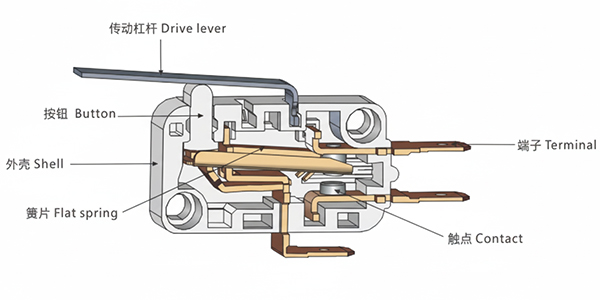
The rice cooker micro switch is typically designed to be compact and robust. Its structure includes the following core components:
-
Actuator (Execution Component): Such as a plunger, button, or lever, this is the interface that receives external force (from the rice cooker’s mechanical or temperature-sensing structure) and converts small external displacement into internal mechanical energy.
-
Fixed and Moving Contacts: These form the points of circuit closure or opening. Contact materials are usually silver alloys, chosen for their excellent conductivity and corrosion resistance under high current loads.
-
Spring or Spring System: This is the core element enabling the “snap-action.” It is an energy storage and release system that, once a critical point is reached, rapidly drives the moving contact to switch positions, guaranteeing consistency and precision in the transition.
-
Housing (Casing): Typically made of high-temperature-resistant, flame-retardant engineering plastic to protect the delicate internal structure and provide effective insulation.
-
Terminals (Connectors): Used to connect external wires, commonly found as solder terminals or quick connect terminals, ensuring a secure connection to the rice cooker’s electrical circuit.
Common Types of Micro Switches in Rice Cookers
The micro switches used in rice cookers are selected based on their specific role in the circuit. While various sizes and actuator styles exist, common types, classified by electrical configuration (poles and throws), include:
-
Single Pole Double Throw (SPDT):
-
Configuration: Features one common terminal (C), one normally open terminal (NO), and one normally closed terminal (NC).
-
Function: This is the core control switch in the rice cooker. It is responsible for instantly switching the circuit from the high-power heating state to the low-power keep-warm state when the cooking process ends (e.g., when the magnet loses its magnetism). Its dual-throw capability is key to automatic tripping.
-
-
Single Pole Single Throw (SPST):
-
Configuration: Features one common terminal (C) and either a normally open (NO) or normally closed (NC) terminal, only responsible for simple circuit connection or disconnection.
-
Function: SPST is commonly used for auxiliary and safety functions, such as:
-
Power Button/Indicator Control: Simple power connection/disconnection.
-
Lid Safety Switch: Detects if the lid is properly closed. The main heating circuit is only allowed to start when the switch is triggered (lid closed), serving as a safety mechanism.
-
-
-
High Sensitivity micro switch:
-
Configuration: Regardless of whether the electrical configuration is SPDT or SPST, these switches are characterized by extremely low operating force and very short travel distance.
-
Function: Primarily used in higher-end rice cookers for precise detection of proper inner pot placement. If the inner pot is removed or incorrectly positioned, the switch immediately breaks the circuit, preventing dry burning. They ensure that even minimal mechanical state changes are captured promptly, enhancing safety redundancy.
-
While the SPDT is most critical for core temperature control, SPST and high-sensitivity switches collectively form the complete safety and control system of the rice cooker.
Operating Principle of the Micro Switch in Rice Cookers
The automatic control function of the rice cooker relies primarily on the ingenious cooperation between the switch and the temperature control component. The temperature control component (such as magnetic steel or a thermistor) is responsible for sensing the critical temperature change at the pot’s base and converting it into mechanical displacement. The micro switch, as the actuator, receives this displacement and uses its snap-action characteristic to instantaneously cut off the high-power heating circuit and connect the low-power keep-warm circuit, thereby ensuring accurate cooking and safety.
In conventional mechanical rice cookers, the core magnetic temperature control switching mechanism relies on the micro switch working in conjunction with a magnetic steel (permanent magnet) or a thermistor to switch between heating and warming:
-
Cooking Mode (Heating):
-
When the “Cook” button is pressed, the mechanism is locked in the heating position. Current flows through the main heating element.
-
The magnetic steel attracts and holds a control lever, keeping the switch contacts in the Normally Closed (NC) position, allowing the high-power heating circuit to conduct.
-
-
Automatic Tripping (Switching):
-
As the water in the rice evaporates, the temperature at the base of the inner pot rapidly increases, reaching a critical point of approximately 103°C to 105°C.
-
At this point, the magnetic steel located at the bottom of the inner pot rapidly loses its magnetism due to reaching its Curie temperature.
-
With the magnetism gone, the control lever loses its attraction and quickly springs up under the force of the spring.
-
The micro switch contacts are driven to switch from NC to NO, and the high-power heating circuit is cut off.
-
-
Keep-Warm Mode:
-
The rice cooker then switches to a separate, low-power keep-warm circuit, which is connected via the micro switch’s other contact.
-
This process is commonly known as “tripping,” and the entire action is guaranteed by the micro switch’s snap-action characteristic, ensuring timely and reliable switching.
-
Common Faults, Diagnosis, and Maintenance of Rice Cooker Micro Switches
The micro switch is a core component of the rice cooker’s control system; any fault will directly impact cooking quality and user safety.
Common Fault Symptoms
Common faults directly related to the micro switch function typically manifest as follows:
-
Failure to Start/Continuous Heating: After pressing the cook button, the button fails to lock into the heating position, or the heating indicator remains on without tripping to the warm state.
-
Undercooked Rice/Premature Tripping: The rice cooker unexpectedly trips before the rice is fully cooked, resulting in undercooked rice. This is often due to degraded performance of the switch’s temperature-sensing component or the magnetic steel, causing the critical temperature threshold to trigger prematurely.
-
Poor Cook Button Feel: The button feels stuck, loose, lacks rebound force, or makes abnormal friction noises when operated. This indicates wear or dirt accumulation in the micro switch’s actuator mechanism.
-
Abnormal Power Indication: The warm indicator light comes on when the cooker should be in the heating state, or vice versa. This usually points to signal feedback failure caused by poor contact or incorrect switching by the micro switch.
Fault Diagnosis and Maintenance
When these fault symptoms occur, follow these steps for diagnosis and troubleshooting:
Diagnosis Steps
-
Power-Off Safety Check: Before performing any operation, be sure to unplug the power cord.
-
Visual Inspection: Open the rice cooker’s base and inspect the micro switch and surrounding wiring for obvious physical damage such as scorching, melting, metal contact oxidation, or rust.
-
Multimeter Continuity Test (Core):
-
Set the multimeter to the resistance range (Ω) or continuity buzzer mode.
-
With the power disconnected, test the resistance between the switch’s common terminal (C) and the normally open (NO)/normally closed (NC) terminals.
-
Under normal conditions:
-
When the switch is pressed: C and NO conduct (resistance near 0 Ω), C and NC are open (resistance infinite ∞).
-
When the switch is released: C and NO conduct, C and NC are open.
-
-
If the test results do not match expectations, or if the resistance value is too high when conducting, it indicates contact oxidation or damage inside the micro switch, requiring replacement.
-
Maintenance and Replacement Recommendations
-
Cleaning and Resetting: For poor contact caused by dust or slight oxidation, you can try cleaning the exterior of the switch after disconnecting power. However, if the fault is internal to the contacts, replacement is mandatory.
-
Replacement Procedure: Before replacing, record the wiring of the old switch. Use a soldering iron to safely remove the old switch’s solder points, then securely solder the new switch of the same model into position, ensuring the wiring is firm and correct.
-
Safety Warning: Non-professionals are advised not to disassemble or replace the switch themselves to avoid causing secondary damage or electric shock hazards.
Selecting the Right Micro Switch for Rice Cookers
Choosing a high-quality micro switch is crucial for ensuring the long-term stable operation of the rice cooker. When procuring, close attention should be paid to the following parameters:
Key Selection Parameters for Rice Cooker Micro Switches
|
Parameter Category |
Consideration Index |
Description (Importance) |
|---|---|---|
|
Rated Electrical Parameters |
Voltage/Current (e.g., 16A 250VAC) |
Must be greater than or equal to the rice cooker’s maximum operating current and voltage. This is the primary factor for ensuring safety. |
|
Mechanical Life |
Number of Operations (e.g., 50,000 cycles) |
Reflects the switch’s durability. Higher cycles mean longer service life. |
|
Temperature Rating |
Operating Temperature Range |
Given the high ambient temperature during rice cooker operation, select a switch with superior heat resistance for its housing and internal components. |
|
Contact Resistance |
Resistance Value (e.g., less than 50 mΩ) |
Lower contact resistance indicates better conductivity and less heat generation. |
|
Protection Rating |
IP Rating |
Although the internal environment of a rice cooker is relatively dry, choosing a switch with some dust protection is advisable. |
|
Certification Standards |
UL, CQC, ENEC, etc. |
Ensures the product has passed official safety certifications, confirming its design and quality comply with international/national standards. |
Brand and Quality of Rice Cooker Micro Switches
When selecting a rice cooker micro switch, the brand and quality are key determinants of its long-term stability. It is recommended to prioritize suppliers with professional qualifications and a strong market reputation in the electrical component industry. The high quality of a micro switch is reflected not only in its core contact material—for example, silver alloy contacts ensure excellent conductivity and effectively resist arc erosion during high-current connection and disconnection, greatly extending service life—but also in its manufacturing process and performance consistency.
A reliable micro switch supplier should be able to provide adequate reliability test data (such as withstand voltage, high-temperature aging, and mechanical life cycle tests). Furthermore, verification of official safety certifications is mandatory, as this is a crucial guarantee that the product meets international or national safety standards. While premium switches may have a slightly higher initial procurement cost, considering the rice cooker is a long-term household appliance, selecting a highly reliable micro switch can effectively reduce future failure rates and maintenance costs, achieving better long-term cost-effectiveness.
Conclusion
The micro switch in a rice cooker is the core component that enables automatic cooking and power safety control. Its snap-action mechanism is vital for completing the switch from heating to warming at the precise temperature, directly influencing the cooking result. Simultaneously, it serves to suppress arcing in high-current circuits, ensuring electrical safety. Therefore, during product design, procurement, and maintenance, strict consideration must be given to the micro switch’s electrical parameters, mechanical life, and reliability. Selecting a high-quality micro switch is fundamental to guaranteeing the long-term stable operation of the rice cooker.



 English
 Russian