
Auxiliary Switch Synchronization: Critical Role in High-Performance Switching
In modern high-speed and high-reliability power systems—especially in high-performance medium-voltage and high-voltage circuit breakers, and applications requiring high-speed reclosing or millisecond-level protection interlocks—timing accuracy is the lifeline for system stability. The Auxiliary Switch, as a key core component of the circuit breaker mechanism, has the fundamental function of transmitting critical timing synchronization information from the mechanical motion domain to the electrical control domain. It not only indicates whether the main contacts are in the “open” or “closed” state but, more critically, accurately captures and transmits the mechanism’s “zero position” and “travel range” information within a microsecond time window.
The mechanical delay, wear gaps, and contact bounce of traditional auxiliary switches can lead to signal errors of up to several milliseconds under high-speed operation. Such errors are unacceptable in relay protection and interlock circuits that demand high coordination. Therefore, the design of a high-precision auxiliary switch is essentially a battle against inertia, impact, and signal distortion during high-speed operation, making it a critical link in achieving high reliability for the power grid.
Five Core Design Elements of High-Precision Auxiliary Switches
To ensure that the auxiliary switch products provide precise and reliable signals in a high-speed operating environment, the design must focus on five core elements, including low inertia, high rigidity, and zero-backlash transmission:
1. Precision Zero-Backlash Transmission Mechanism: The Mechanical Precision Cornerstone
High-precision auxiliary switches utilize a precisely machined cam or gear transmission system, replacing traditional simple linkages. The key to the design lies in achieving a rigid, zero-backlash coupling with the main shaft of the switching equipment mechanism. This precision transmission system minimizes non-linear errors and dead zones during the transmission process, serving as the mechanical foundation for ensuring absolute synchronization between the auxiliary contact position and the main contact position. Any minute clearance will be amplified into an uncontrollable timing error during high-speed switching.
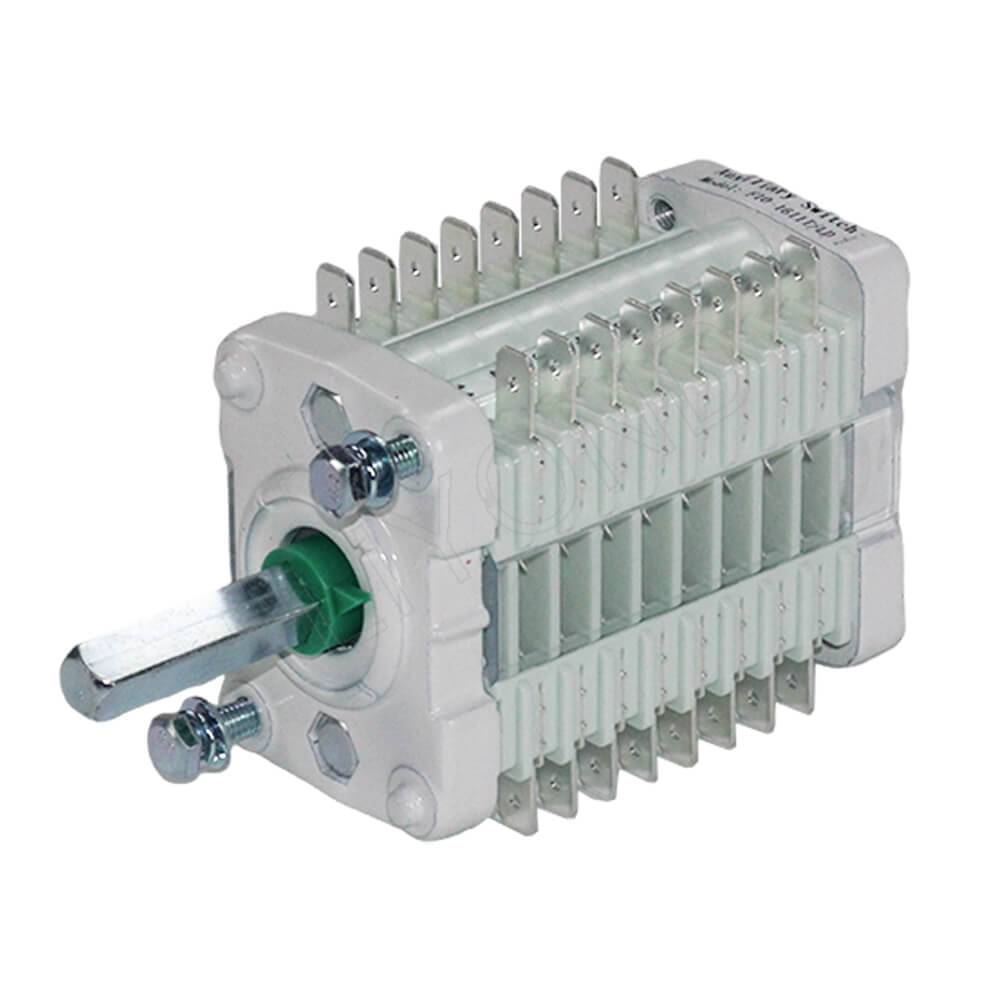
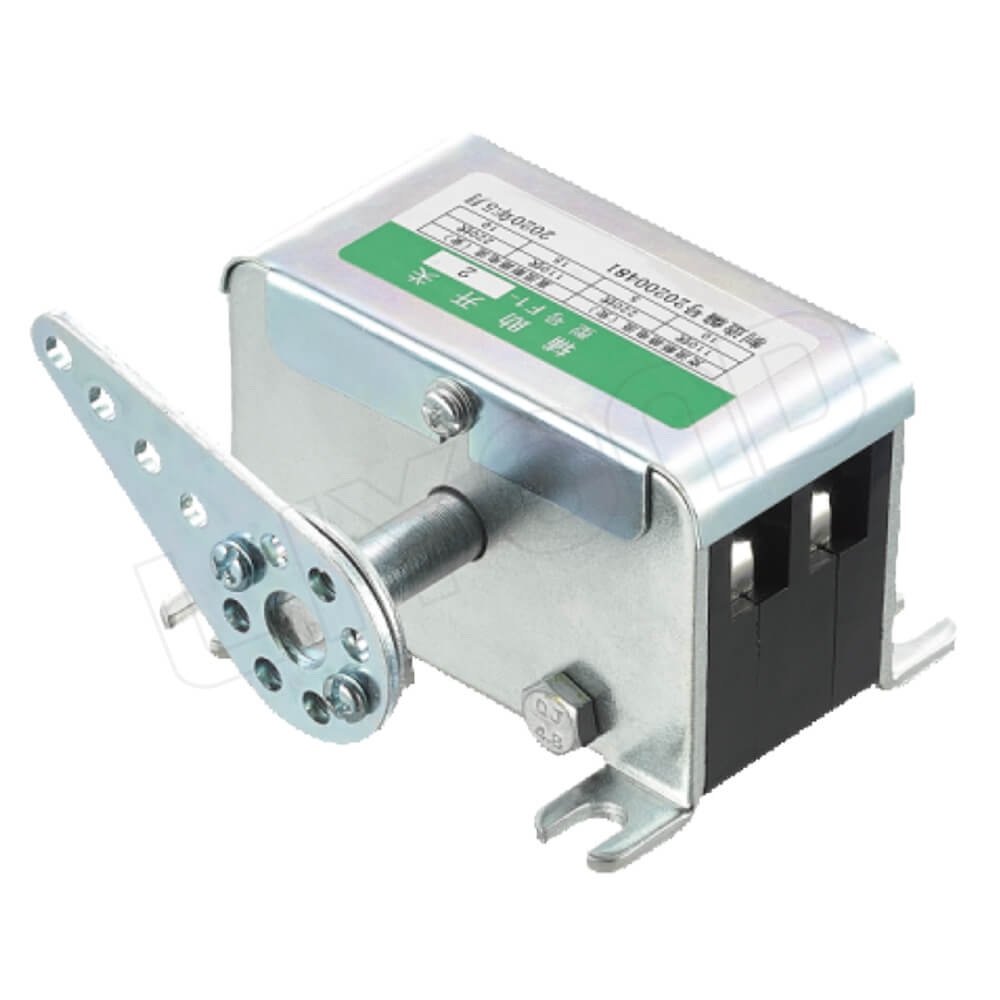
2. Optimized Moving Contact for Low-Inertia Response: Electrical Speed Assurance
The material selection and geometry of the contact assembly directly impact its response speed. High-performance auxiliary switches employ lightweight, highly conductive alloy materials and optimize the contact bridge structure to significantly reduce their intrinsic inertia. Lower inertia means the contacts can complete switching at a faster acceleration and speed, thereby markedly shortening the signal’s electrical response time (the Intrinsic Delay) and ensuring the instantaneity of the signal transition relative to the main contact movement.
3. High Anti-Vibration Structure and Material Selection: Environmental Stability
The switch housing and internal components must possess robust anti-vibration capabilities. By selecting high-strength, high-damping engineering plastics or castings and utilizing a stable contact support structure, the design effectively absorbs and suppresses the transient impact energy generated by the high-speed operating mechanism. This structurally ensures that the contacts will not experience Contact Bounce or permanent displacement under severe vibration, maintaining the signal’s purity.
4. Contact Material and Long-Life Durability Design: Long-Term Consistency
Another vital indicator of high precision is long-term consistency. Precision auxiliary switches require contact materials with excellent wear resistance and arc corrosion resistance (such as specific silver alloys, often enhanced with plating). Furthermore, internal moving parts must utilize high-hardness, low-friction materials coupled with lifetime lubrication designs. This guarantees that the synchronization points will not drift due to mechanical wear after tens or even hundreds of thousands of operation cycles, thus ensuring reliability over the full life cycle.
Related reading: How Micro Switch Contact Materials Affect Performance
5. Modular Design and Installation Precision Control: Integration and Usability
The design must not only pursue component precision but also ensure accuracy during on-site installation. High-precision auxiliary switches typically employ a pre-calibrated modular design, completing complex calibration processes in the factory. The interface connecting the module to the circuit breaker mechanism uses high-precision locating pins or flanges to eliminate the accumulation of tolerances that might be introduced during field installation, ensuring that factory-level accuracy is accurately transferred to the customer’s application, thereby reducing integration difficulty and the complexity of on-site maintenance.
Conclusion and Future Trends
In summary, the design of a high-precision auxiliary switch is a systematic integration of precision mechanics, electrical engineering, and materials science. Its five core elements—precision transmission, low-inertia response, high anti-vibration structure, long-life durability, and modular installation—are not isolated but are mutually synergistic and indispensable. This collaborative design aims to comprehensively solve the mechanical synchronization issues at the input end, the electrical speed issues at the output end, and the problems of environmental interference and long-term reliability under high-speed operation, ensuring the continuous provision of microsecond-accurate timing synchronization signals under extreme working conditions.
Looking ahead, the auxiliary switch will move beyond its role as a simple mechanical signal indicator, evolving into a deeper integration with digital and smart technologies. Future trends include embedding edge computing chips within the module to achieve hardware-level signal debouncing, timestamp recording, and self-diagnosis capabilities. Simultaneously, the introduction of non-contact sensing technology is expected to completely eliminate precision degradation caused by mechanical wear, leading to even higher speeds and longer service lives. Ultimately, the high-precision auxiliary switch will be upgraded to a High-Reliability Timing Data Acquisition Unit, indispensable in smart grids and real-time protection control, providing a solid data foundation for power equipment asset management and system security operation.

 English
 Russian